research
Links to working papers will be uploaded in due course. Till then, please reach out out via e-mail and I will be happy to share research drafts.
2025
-
 The Inequality Multiplier: Market Inelasticity and the Persistence of Wealth InequalityCharles Christopher Hyland and Aditya Khemka2025
Saïd Foundation Award for Best Doctoral Paper in Finance, 2025
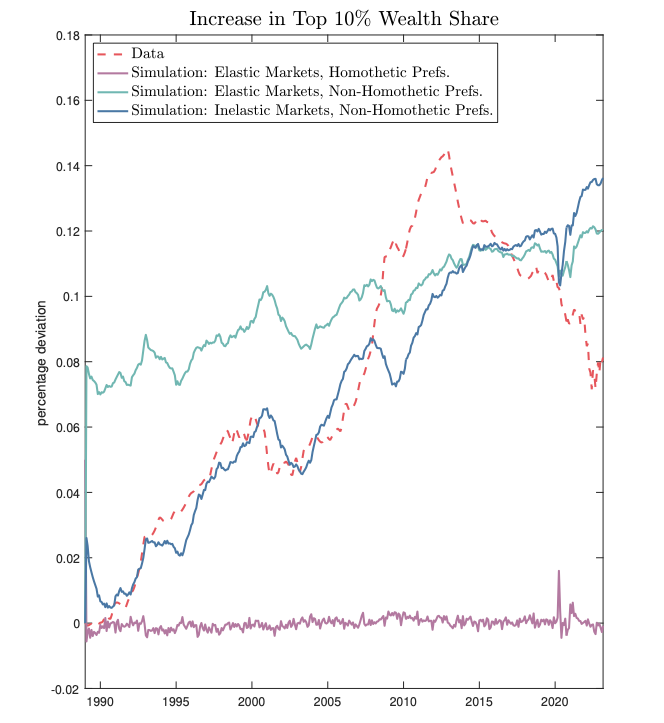
We study how frictions in financial intermediation transmit income inequality into wealth inequality. When mandate-constrained intermediaries maintain stable allocations between equity and debt—keeping equity demand inelastic—household saving and borrowing flows affect equity prices rather than being absorbed entirely through quantities. Greater saving by wealthy households and greater borrowing elsewhere in the distribution both expand intermediary balance sheets and raise equity valuations. Because equity ownership is concentrated, these revaluations redistribute wealth toward the top—an amplification mechanism we call the inequality multiplier. We develop a general equilibrium model with heterogeneous households and calibrate it to the United States from 1989 to 2023. Inelastic pricing roughly doubles the response of wealth inequality relative to an elastic market benchmark, and the multiplier strengthens as wealth becomes more concentrated. Because the income inequality generating these flows is persistent, the resulting wealth concentration is durable. Consistent with the mechanism, the component of equity returns predicted by fund flows generates persistent shifts in wealth shares, whereas the response to fundamental components mean reverts. Our results show that wealth inequality depends not only on household saving and portfolio exposure, but also on how financial institutions transmit distributional flows into asset prices.
EEA-ESEM 2026 Dublin (August 2026), ISB Summer Research Conference (July 2026), AFA Annual Meeting Poster Session (January 2026), Bank of England Macro Brown Bag (July 2025); Asian Finance Association, Taipei (June 2025); Trans-Atlantic Doctoral Conference, London Business School (June 2025); Rethinking Economic Theory Conference, Athens (December 2024)
-
 Green Policy, Unequal OutcomesAditya Khemka and Dimitrios P. Tsomocos2025
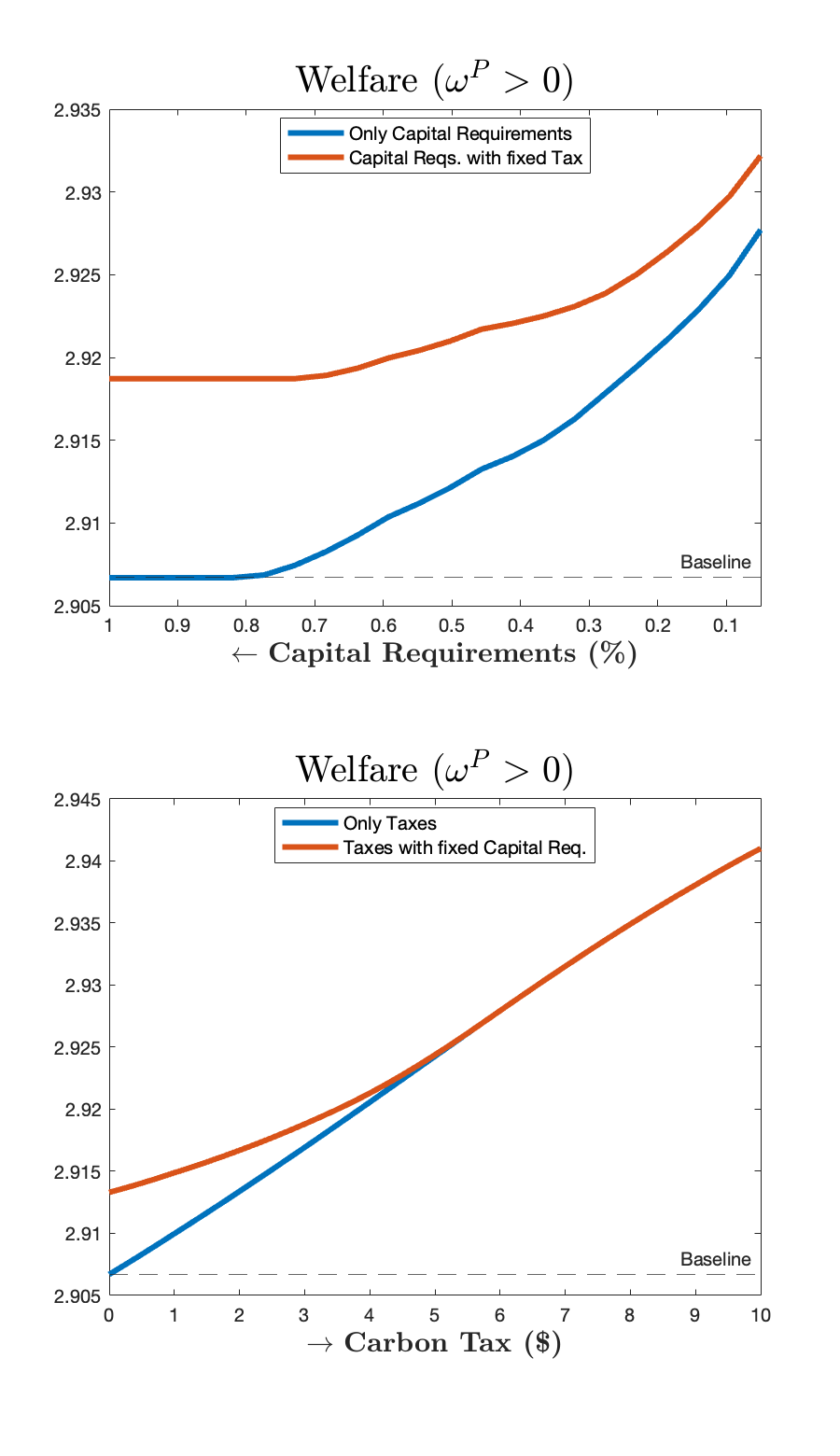
We investigate how climate-focused financial regulations impact wealth inequality and economic welfare. Who loses on the climate transition path and/or due to environment policy? Which trade-offs should policy makers address? We develop a two-period general equilibrium model with heterogeneous households, incomplete markets, and endogenous climate damages to assess the effects of green capital requirements and carbon taxes. Our findings reveal that while green capital regulations reduce pollution, they also constrain credit allocation, lowering aggregate efficiency and amplifying wealth inequality through labor market distortions. We identify a fundamental trade-off: policies that effectively mitigate environmental harm tend to increase inequality, while those that reduce inequality often fall short in addressing climate risks. We show that carbon taxes outperform green capital regulations in reducing emissions and cause a smaller rise in inequality. Empirical evidence supports these findings, particularly in developed economies where credit contraction exacerbates distributional disparities. Our results highlight the need for policymakers to balance environmental goals with equity considerations in designing climate policy.
Bank of England Financial Stability Seminars (September 2025), Bank of England PPD Research Discussion Group (May 2025); Oxford Saïd - VU SBE Macro-finance Conference, Oxford (June 2024); IV Central Bank Conference on Environmental Risks, Mexico City (December 2023)
-
 Climate change, macroprudential policy responses and their distributional consequences in South AfricaAditya Khemka, Christina Laskaridis, and Dimitrios P. TsomocosSouth African Reserve Bank Working Paper Series, 2025
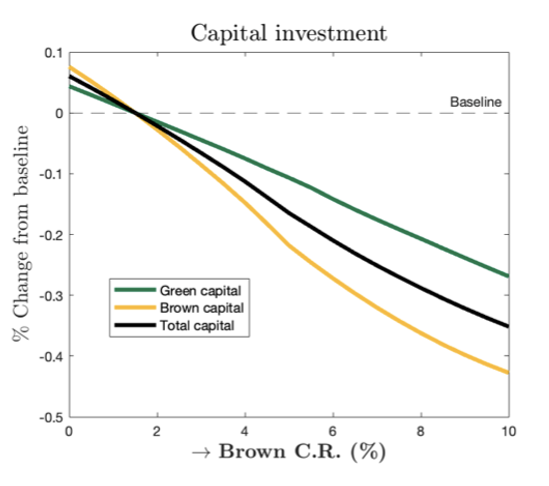
In transitioning from coal-dependent growth to a low-carbon economy, South Africa faces intertwined environmental, macro-financial and distributional risks. We build a two-period computable general equilibrium model with heterogeneous households, firms and a dual- tier banking system, embedding endogenous default, brown and green capital markets and a pollution-damage feedback. After calibrating to South African data, we compare three instruments – downstream carbon taxes, brown risk-weighted capital surcharges and green capital discounts – individually and jointly. Carbon taxation most sharply curbs emissions and, when revenues are rebated to workers, also narrows wealth and consumption inequality. Brown penalising factors restrain leverage and reduce default probabilities but raise energy prices and widen wage inequality; green supporting factors lower financing costs yet trigger a Jevons-type rebound that can increase coal demand. Welfare decompositions show that no single tool dominates; the optimal approach involves pairing a carbon tax with prudential tweaks that balance climate gains, stability and equity for South Africa.
Committee of Central Bank Governors in SADC (CCBG) Climate Change Policy Dialogue, Lusaka (July 2025)